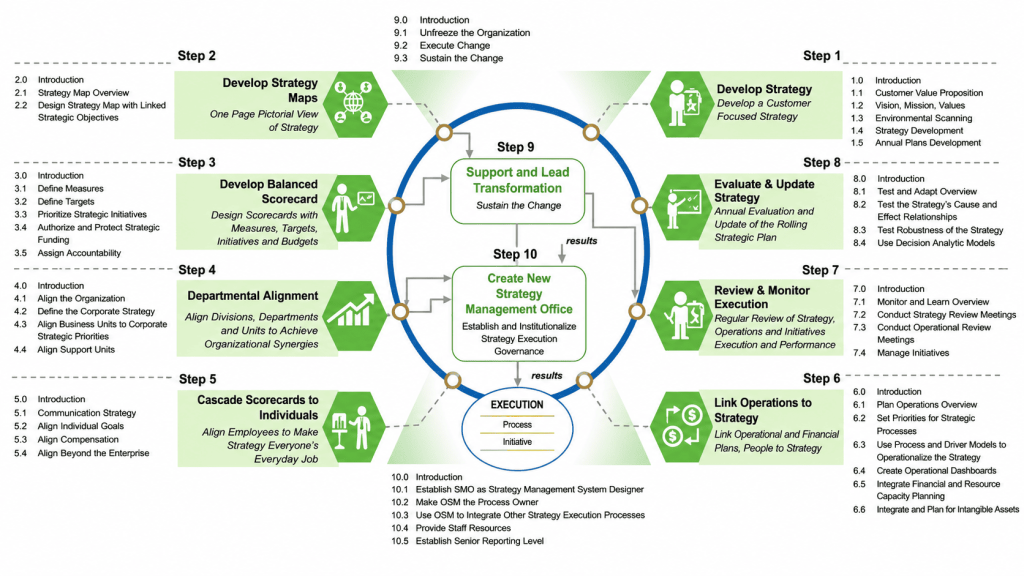
BSCi EMEA 10 Steps Execution Success Process (XSP)
A structured approach for developing, aligning, executing, monitoring and institutionalizing strategy.Step 1
Develop Strategy
Objective: Develop a Customer-Focused Strategy
Contents
- 1.0 Introduction
- 1.1 Customer Value Proposition
- 1.2 Vision, Mission, Values
- 1.3 Environmental Scanning
- 1.4 Strategy Development
- 1.5 Annual Plans Development
Step 2
Develop Strategy Maps
Objective: One-Page Pictorial View of Strategy
Contents
- 2.0 Introduction
- 2.1 Strategy Map Overview
- 2.2 Design Strategy Map with Linked Strategic Objectives
Step 3
Develop Balanced Scorecard
Objective: Design Scorecards with Measures, Targets, Initiatives and Budgets
Contents
- 3.0 Introduction
- 3.1 Define Measures
- 3.2 Define Targets
- 3.3 Prioritize Strategic Initiatives
- 3.4 Authorize and Protect Strategic Funding
- 3.5 Assign Accountability
Step 4
Departmental Alignment
Objective: Align Divisions, Departments and Units to Achieve Organizational Synergies
Contents
- 4.0 Introduction
- 4.1 Align the Organization
- 4.2 Define the Corporate Strategy
- 4.3 Align Business Units to Corporate Strategic Priorities
- 4.4 Align Support Units
Step 5
Cascade Scorecards to Individuals
Objective: Align Employees to Make Strategy Everyone’s Everyday Job
Contents
- 5.0 Introduction
- 5.1 Communication Strategy
- 5.2 Align Individual Goals
- 5.3 Align Compensation
- 5.4 Align Beyond the Enterprise
Step 6
Link Operations to Strategy
Objective: Link Operational and Financial Plans, People to Strategy
Contents
- 6.0 Introduction
- 6.1 Plan Operations Overview
- 6.2 Set Priorities for Strategic Processes
- 6.3 Use Process and Driver Models to Operationalize the Strategy
- 6.4 Create Operational Dashboards
- 6.5 Integrate Financial and Resource Capacity Planning
- 6.6 Integrate and Plan for Intangible Assets
Step 7
Review & Monitor Execution
Objective: Regular Review of Strategy, Operations and Initiatives Execution and Performance
Contents
- 7.0 Introduction
- 7.1 Monitor and Learn Overview
- 7.2 Conduct Strategy Review Meetings
- 7.3 Conduct Operational Review Meetings
- 7.4 Manage Initiatives
Step 8
Evaluate & Update Strategy
Objective: Annual Evaluation and Update of the Rolling Strategic Plan
Contents
- 8.0 Introduction
- 8.1 Test and Adapt Overview
- 8.2 Test the Strategy’s Cause and Effect Relationships
- 8.3 Test Robustness of the Strategy
- 8.4 Use Decision Analytic Models
Step 9
Support and Lead Transformation
Objective: Sustain the Change
Contents
- 9.0 Introduction
- 9.1 Unfreeze the Organization
- 9.2 Execute Change
- 9.3 Sustain the Change
Step 10
Create New Strategy Management Office (SMO)
Objective: Establish and Institutionalize Strategy Execution Governance
Contents
- 10.0 Introduction
- 10.1 Establish SMO as Strategy Management System Designer
- 10.2 Make OSM the Process Owner
- 10.3 Use OSM to Integrate Other Strategy Execution Processes
- 10.4 Provide Staff Resources
- 10.5 Establish Senior Reporting Level